
Smooth a profile
Adding small amounts above and around a dorsal prominence can create a straighter-looking profile in selected noses.
Carefully placed hyaluronic acid filler can refine selected aspects of the bridge, radix and tip to create a straighter or more balanced profile without surgery.
Nose filler does not make the nose physically smaller. Instead, strategic volume can alter contour and optical balance — for example, by smoothing a dorsal irregularity or improving selected tip proportions.
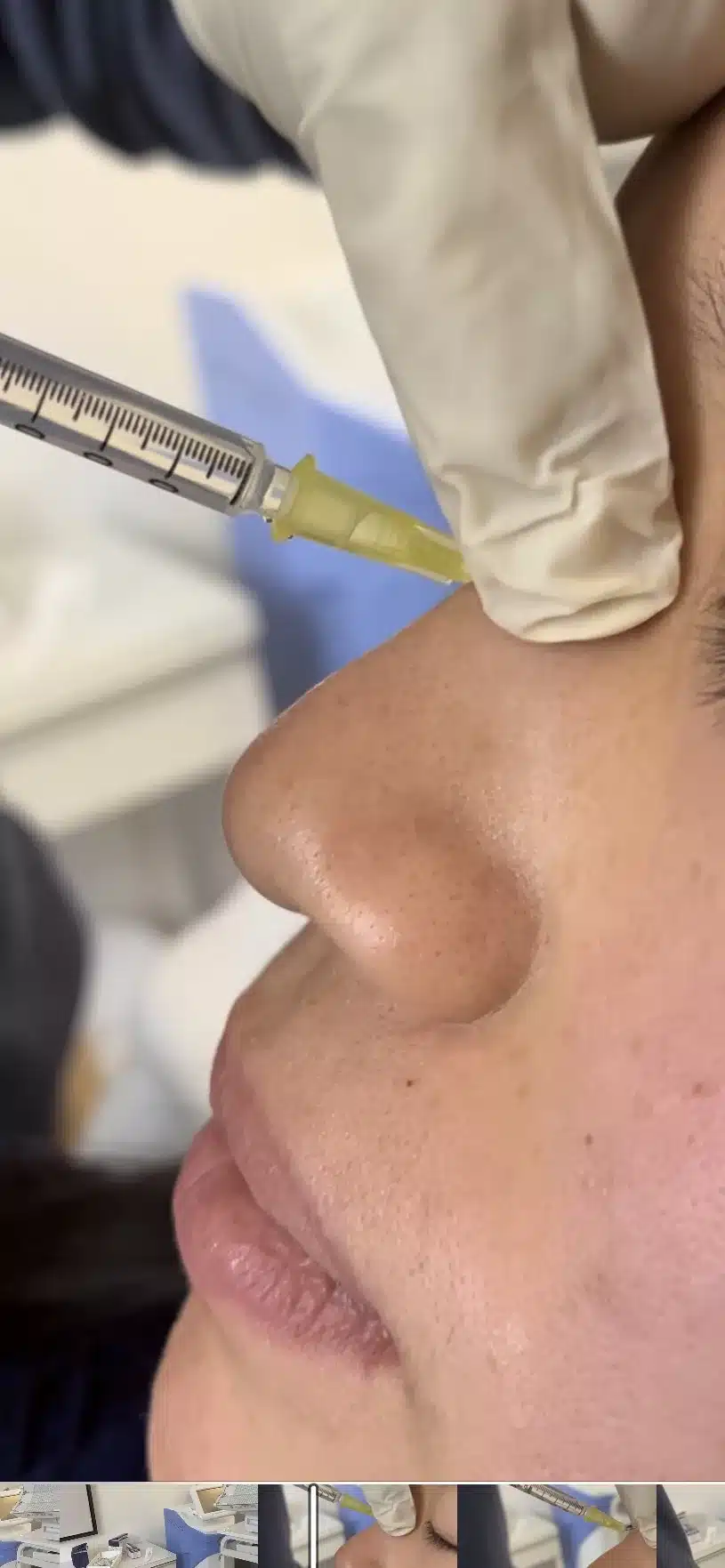
Non-surgical rhinoplasty uses dermal filler to alter selected contours of the nose without cutting bone or cartilage.
Small amounts of temporary hyaluronic acid filler may be placed at specific points to improve continuity of the bridge, support selected tip shapes or create better balance with the surrounding profile.
The treatment works by adding volume in carefully chosen areas. It cannot remove tissue, narrow nasal bones or correct functional breathing problems.
Adding small amounts above and around a dorsal prominence can create a straighter-looking profile in selected noses.
Where the upper bridge is low, carefully placed filler may improve continuity between forehead and nasal bridge.
In some anatomies, conservative placement can improve support or balance around the nasal tip.
Filler adds volume. A profile may look more balanced, but the nose has not physically become smaller.
A broad bony nose cannot be made narrower with filler. Surgical rhinoplasty is required for structural reduction.
Functional nasal obstruction, septal deviation and breathing concerns require appropriate ENT or surgical assessment.
This is one of the counter-intuitive aspects of non-surgical rhinoplasty. If a profile has a visible dip above a dorsal hump, selectively filling that depression can create a smoother line from the forehead towards the nasal tip.
The nose is therefore not reduced. The surrounding contour is changed, which can make the profile appear straighter and more proportionate.
This video shows a non-surgical rhinoplasty treatment at Santi. The treatment is planned around the individual's nasal anatomy and profile rather than following a standard injection pattern.
Nose filler requires particularly careful anatomical assessment, conservative product placement and an understanding of the vascular structures in and around the nose.
The upper bridge is assessed in relation to forehead projection and the overall facial profile.
We examine the bridge for humps, depressions, asymmetry and existing filler before deciding whether treatment is appropriate.
Tip rotation, projection and support are considered carefully. Not every tip concern is suitable for filler.
A weak or retrusive chin can make a nose appear more prominent in profile. Sometimes the better approach is to consider overall profile balance rather than adding more filler to the nose.
Existing nasal filler can alter both anatomy and treatment planning. We assess previous product before deciding whether additional filler is appropriate.
Where reduction, substantial structural change or functional correction is required, surgical rhinoplasty may be the more appropriate option.
We review medical history, previous filler or surgery, nasal anatomy, profile and the change you are hoping to achieve.
If treatment is appropriate, the clinician identifies the precise areas where added volume may improve contour while keeping the plan conservative.
Small amounts of hyaluronic acid filler are placed using a technique selected according to your individual anatomy and treatment area.
The contour is assessed immediately, with further evaluation once minor swelling has settled over the following 1–2 weeks.
| Concern | Nose filler | Surgical rhinoplasty |
|---|---|---|
| Small profile irregularity | May be appropriate | Possible, although surgery may be unnecessary for a minor concern |
| Low radix | May be improved by carefully selected augmentation | Can also be addressed surgically |
| Large nose | Cannot reduce the physical size | Required if structural reduction is the goal |
| Wide nasal bones | Cannot narrow them | Surgical treatment required for narrowing |
| Major tip reshaping | Limited | Provides greater structural control |
| Breathing or septal issues | Not a treatment for functional obstruction | Requires appropriate surgical or ENT assessment |
Contour changes are visible immediately, although mild swelling or redness can temporarily alter the appearance.
The area generally settles and the filler integrates, giving a better sense of the final contour.
Results may last within this broad range depending on product, placement, metabolism and individual factors.
Although serious complications are uncommon, the consequences of vascular compromise in the nose can be significant. This is why assessment, anatomy, technique and informed consent are particularly important for this treatment.
Dermal filler can rarely enter or compress a blood vessel, resulting in reduced blood supply to skin and surrounding tissue.
Because the vascular anatomy of the nose communicates with vessels supplying the eye, visual disturbance and permanent visual loss are recognised rare complications of nasal filler.
These risks are discussed as part of the consultation and informed consent process.
Any sudden visual change, visual loss, severe eye pain or unusual neurological symptom following filler treatment requires immediate emergency medical attention.
You will receive individual aftercare and emergency contact guidance following treatment.
Hyaluronic acid fillers provide temporary, adjustable augmentation. They gradually break down over time rather than creating a permanent implant.
Where clinically appropriate, HA filler can also be treated with hyaluronidase.
Hyaluronidase is not used casually. It has its own risks and is administered according to clinical need — for example, where filler needs to be reduced, corrected or urgently treated in the context of a vascular complication.
Non-surgical rhinoplasty is priced from £500 per ml. Approximately 1 ml is commonly sufficient for a conservative treatment, although the appropriate amount depends on anatomy, previous filler and the areas being treated.
The final treatment plan and fee are confirmed following consultation.
Avoid unnecessary pressure, rubbing or manipulation of the nose unless your clinician specifically advises otherwise.
Temporary redness, tenderness or swelling can occur and usually settles progressively.
Sauna, steam and excessive heat are generally avoided while swelling and inflammation are settling.
Your clinician may advise limiting strenuous exercise during the immediate post-treatment period.
If filler has been placed where glasses exert pressure, your clinician may provide specific advice about wearing them after treatment.
Unusual pain, skin colour change or visual symptoms should never simply be watched at home. Follow the emergency guidance provided by the clinic.
No. Dermal filler adds volume. In carefully selected cases, changing the surrounding contour can make a hump less obvious or the profile look straighter, but the nose itself has not become physically smaller.
It can sometimes make a mild or moderate hump appear less prominent by adding volume to adjacent depressions and creating a straighter profile line. Suitability depends on the individual anatomy.
Selected tip shapes may be refined or supported with filler, but the degree of change is limited. Significant tip reshaping is a surgical rather than filler procedure.
Around 1 ml is common for a conservative non-surgical rhinoplasty, but this is not a fixed dose. Some patients require less and others may not be suitable for filler at all.
An indicative range is approximately 9–18 months, depending on the filler used, placement, metabolism and individual factors.
Most treatments do not result in serious complications, but nasal filler carries recognised vascular risks, including rare cases of skin injury and visual complications. These risks are discussed as part of informed consent before treatment.
Visual loss is a rare but recognised complication of filler injection in the nose and other areas connected to the vascular supply of the eye. This is one reason why nasal filler requires particularly careful assessment, technique and informed consent.
Hyaluronic acid filler can often be treated with hyaluronidase where clinically appropriate. Dissolving is itself a medical treatment and is performed according to clinical need.
Filler is most useful for selected contour and profile changes. If you want the nose physically reduced, narrowed, substantially reshaped or need functional correction, surgery is usually the more appropriate route.
Book a consultation to discuss the change you want to achieve and whether adding filler is genuinely the right approach for your nose. Where filler cannot safely or realistically deliver the result, we will say so.
Nose filler from £500 per ml · Approximately 1 ml commonly used · Indicative longevity 9–18 months · Treatment subject to consultation, anatomical assessment and medical suitability · Santi London, 33 Thurloe Street, South Kensington, London SW7 2LQ.