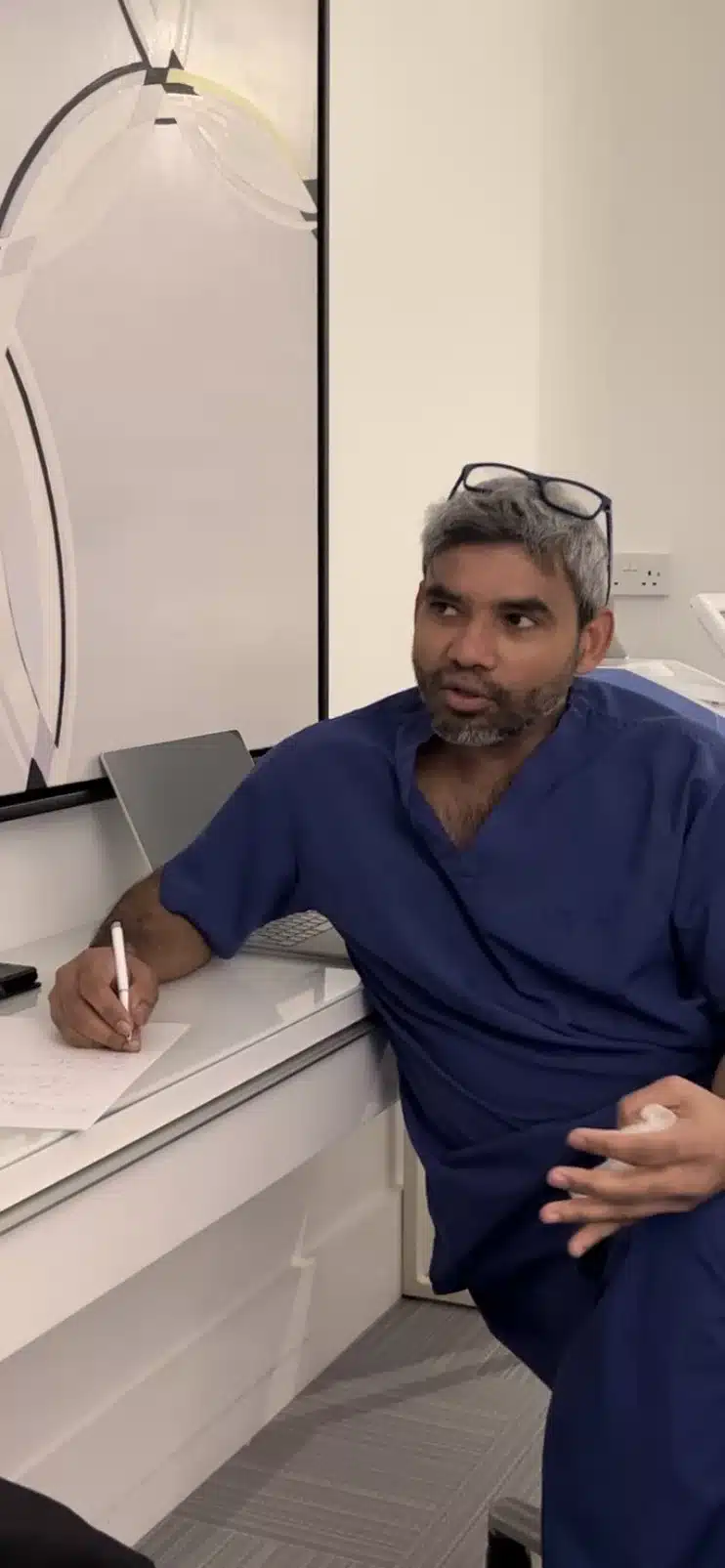
Consultant-led hyaluronic acid cheek filler at Santi London, established in South Kensington in 2009. We assess mid-face volume loss, facial proportions and the relationship between the cheeks, under-eye area and lower face before recommending treatment.
Consultation-ledCannula/needle optionsNumbing available
DowntimeSwelling and bruising may last several days or longer
Typical amountIndividual assessment; no fixed volume
Longevity~9–18 months
Understanding mid-face volume loss
Why cheeks change with age
Facial ageing involves changes in bone, fat compartments, skin and supporting tissues. Loss of mid-face projection can contribute to flatter cheeks, under-eye shadows and more visible folds. Filler can restore selected volume deficits, but it cannot reproduce a surgical lift or correct every cause of sagging.
Who may benefit?
Adults concerned about loss of cheek definition, asymmetry or reduced mid-face support may benefit after assessment. Where puffiness, skin laxity or existing filler is the main concern, adding volume may be inappropriate.
Consultant-led facial assessment
Dr Mobin Saeed brings a plastic surgery perspective to facial anatomy and treatment planning.
Smoother transition to the under-eye (often without direct tear trough filler)
Profile balance and facial symmetry
Suitability, alternatives and safety
Safety first
Medical history, previous filler and individual anatomy are assessed before treatment. Hyaluronic acid filler may be dissolved when clinically indicated, but reversal is not guaranteed and has its own risks.
When we pivot
For very thin under-eye skin, we often prioritise cheek support or skin boosters / polynucleotides rather than direct tear-trough filler.
Combination planning
Cheek support pairs well with skin boosters for quality, or lower-face strategies for balance.
Risks and urgent warning signs
Bruising, swelling, tenderness, infection, lumps and asymmetry can occur. Rare vascular occlusion can cause tissue damage, blindness or stroke. Seek immediate clinical assessment for unusual or increasing pain, pale, mottled or dusky skin. For sudden visual changes or stroke symptoms, call 999 immediately. Do not wait for a routine review.
Cheek filler prices in London
Cheek filler is £500 per ml. The appropriate amount and total cost are agreed before treatment; the amounts below are illustrative, not recommendations.
Not suitable during pregnancy/breastfeeding. Medical consultation required.
Preparing for treatment and aftercare
Before your visit
Disclose medicines, supplements, allergies, previous filler and medical conditions. Do not stop prescribed medication without advice from your prescriber. Tell us if you are unwell or have an active infection.
Aftercare
Skip saunas/strenuous exercise for 24–48h. Avoid pressure/massage unless advised. Minimal makeup after 12–24h.
Longevity
Effects may last around 9–18 months, depending on product and individual factors. Filler may remain present longer than the visible effect. Further treatment is considered only after reassessment.
Cheek filler FAQs
Will it look natural?
We aim for proportionate results using individual assessment and conservative treatment where appropriate. Outcomes vary and cannot be guaranteed.
Do I need tear trough filler as well?
Often not. Mid-face support can improve the under-eye indirectly. If skin is very thin, we may suggest polynucleotides/boosters instead.
Does it hurt?
Discomfort is usually mild and brief. Topical numbing and cannula techniques can improve comfort.
Any risks?
Bruising, swelling and asymmetry are possible; rare but serious risks include vascular occlusion. We use vessel-aware technique and have protocols for urgent management.
Can cheek filler replace a facelift?
No. Filler can restore selected volume loss but does not remove excess skin or reposition tissues in the same way as surgery.