
Consultation
We discuss your skin concerns, skincare products, previous treatments, relevant history and what you would like to understand or improve.
Understand your skin beyond what the mirror can show. Our clinician-led Skin Lab combines advanced imaging, objective measurements and personalised interpretation to help you make more informed skincare and treatment decisions.
From hydration and barrier function to elasticity, pigmentation and assessment of the collagen-rich dermis, Skin Lab creates a measurable starting point and helps track how your skin changes over time.
Our approach combines sophisticated imaging and measurement technology with clinical interpretation, helping turn skin data into practical decisions.
Skin Lab FX technology supplied by Templar Skin Systems
Skin health and appearance are influenced by several interacting factors. Measuring them separately — and interpreting them together — can help identify priorities and evaluate change more reliably.
High-frequency ultrasound images the collagen-rich dermis and helps assess characteristics such as thickness and echogenicity.
Explore Dermal Imaging →Measure skin recoil and mechanical behaviour, supporting comparison over time.
Explore Elasticity →Assess surface hydration rather than relying only on how the skin feels.
Explore Hydration →Assess transepidermal water loss to help understand the skin's barrier function.
Explore TEWL →Measure oil production across selected areas of the skin.
Explore Sebum →Assess skin colour and pigmentation under controlled measurement conditions.
Explore Skin Colour →Explore the relationship between glycation and visible changes associated with ageing.
Explore Glycation →Understand acid-mantle balance and its relationship with barrier function and skin comfort.
Explore Skin pH →Surface imaging helps us assess visible changes. High-frequency ultrasound provides an additional way to examine characteristics of the dermis beneath the surface.
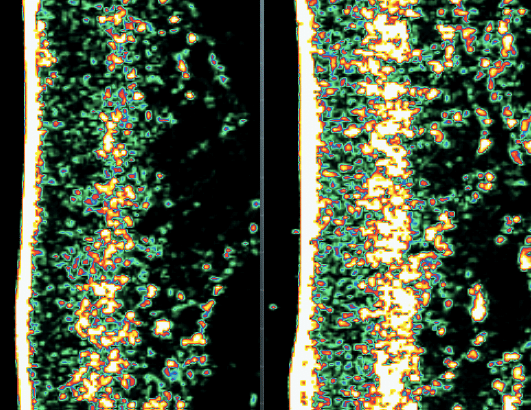
Collagen is an important structural component of the dermis. High-frequency ultrasound can provide repeatable measurements of dermal characteristics such as thickness and echogenicity.
This is useful when investigating changes over time, including in carefully designed skincare efficacy studies and selected treatment-monitoring protocols.
Ultrasound does not directly count collagen fibres or independently prove new collagen production. Measurements must be interpreted alongside the clinical context and other relevant parameters.
Learn About Collagen Measurement →Skin Lab is not about producing a collection of impressive-looking numbers. It is about understanding which measurements matter and what to do with them.
Skin measurements are interpreted alongside your skincare routine, previous treatments, medical history, lifestyle, environment and individual concerns.
That allows us to identify priorities, avoid unnecessary complexity and develop a plan that can be reviewed over time.
We discuss your skin concerns, skincare products, previous treatments, relevant history and what you would like to understand or improve.
We capture standardised images and undertake selected measurements to create an objective baseline relevant to your concerns.
We explain the findings, discuss skincare and treatment priorities, and provide a written summary with recommended next steps.
Hydration and TEWL measurements can help distinguish low surface hydration from increased water loss through the barrier.
Dermal ultrasound provides structural measurements beneath the visible skin surface, where appropriate.
Explore Dermal Ultrasound →Measuring oil production can help clarify patterns of oiliness and inform skincare choices.
Explore Sebum →Controlled imaging can help document visible pigment distribution and changes over time.
Comparable photography and appropriate measurements can support monitoring of visible redness.
Mechanical and imaging-based measurements can support assessment of changes in firmness, recoil and surface appearance.
Explore Elasticity →Skin Lab does not replace dermatological assessment of suspected skin disease.
Standardised photographs for more meaningful comparisons over time.
A clear overview of relevant measurements and findings.
Recommendations for your skincare routine and appropriate next steps.
Guidance on what to monitor and when to reassess.
Santi Skin Lab is more than a consumer skin assessment service. Our experience with objective skin measurements also supports professional discussions about clinical applications, product efficacy and the use of skin analysis technology.
Santi can discuss structured measurement programmes designed to evaluate skincare, devices and treatments using appropriate objective endpoints.
Depending on the study design, these may include hydration, TEWL, elasticity, sebum, standardised imaging and high-frequency dermal ultrasound.
Our emphasis is on selecting meaningful measurements, establishing comparable baselines and interpreting changes responsibly.
Interested in introducing more objective skin assessment into your own clinic, spa or skincare business?
Santi uses Skin Lab FX technology supplied by Templar Skin Systems .
The technology combines skin imaging and measurement probes to support consultations, personalised recommendations and progress tracking.
You are welcome to contact Santi to discuss our practical experience of using skin analysis in a clinical setting. For equipment specifications and supply, visit Templar directly.
Visit Templar Skin Systems →Your Skin Lab findings can help inform whether a particular treatment is appropriate, or whether changes to your skincare routine should come first.
Selected pigmentation, congestion and texture concerns.
Explore Peels →Treatment options for selected skin-quality and texture concerns.
Explore Microneedling →Targeted approaches for pigmentation, redness and resurfacing.
Explore Laser Clinic →Injectable skin-quality treatments for selected concerns.
Explore Polynucleotides →A comprehensive Santi Skin Lab assessment costs £160 and typically takes 45–60 minutes.
The appointment includes consultation, standardised imaging, selected objective measurements, interpretation and personalised recommendations with written next steps. Measurements are chosen according to your individual concerns and assessment needs.
Santi uses high-frequency ultrasound to image the collagen-rich dermis and assess characteristics including thickness and echogenicity. This does not directly count collagen fibres or establish collagen production on its own.
Not necessarily. The selection of imaging and measurements depends on the purpose of your appointment. Ultrasound may be appropriate for specific dermal assessments or measurement protocols.
We will advise you when booking. Certain products, recent treatments and environmental conditions can affect measurements, so preparation may be recommended to improve comparability.
Most imaging and skin measurements are non-invasive. Some tests may need to be postponed if your skin is actively irritated or inflamed.
Yes. Repeatable measurements can help document changes over time, provided the measurement conditions and timing are sufficiently comparable.
Follow-up intervals depend on what you are tracking. For some skincare or treatment programmes, a reassessment after approximately 6–12 weeks may be useful.
The Skin Lab FX technology used at Santi is supplied by Templar Skin Systems . Santi also uses additional assessment methods, including high-frequency ultrasound for selected dermal measurements.
Yes. Professional visitors can contact Santi to discuss our practical experience of using objective skin analysis, and brands can enquire about measurement-led efficacy studies. Equipment supply enquiries can also be directed to Templar Skin Systems.
No. Skin Lab supports skin assessment, skincare planning and monitoring, but does not replace medical or dermatological diagnosis where required.
Start with a clearer picture of your skin and a plan informed by objective measurements, not guesswork.
Santi London · 33 Thurloe Street · South Kensington · London SW7 2LQ
© Santi London · Privacy Policy · Terms