
Skin texture
Dullness, fine lines, crepey texture and early loss of skin quality.
Platelet-rich plasma is prepared from your own blood and used to support selected skin-quality and hair-thinning concerns — with realistic expectations, careful diagnosis and a planned course rather than a one-off “miracle” treatment.
PRP is not a dermal filler and it does not reshape the face. It is used when the aim is to support skin quality, repair signalling or the environment around active hair follicles.
Dullness, fine lines, crepey texture and early loss of skin quality.
Selected peri-orbital concerns after careful assessment of anatomy and technique.
Early-to-moderate thinning where follicles remain active and a wider hair plan makes sense.
Uses platelet-derived growth factors and signalling proteins to support tissue repair pathways.
A small sample of blood is drawn and processed in a centrifuge to separate and concentrate the platelet-rich plasma. The prepared PRP is then placed into the target area using fine injections, cannula or microneedling depending on the indication.
These real treatment images show the separation stage after centrifugation and help explain what the clinician is looking for before PRP is drawn for use.
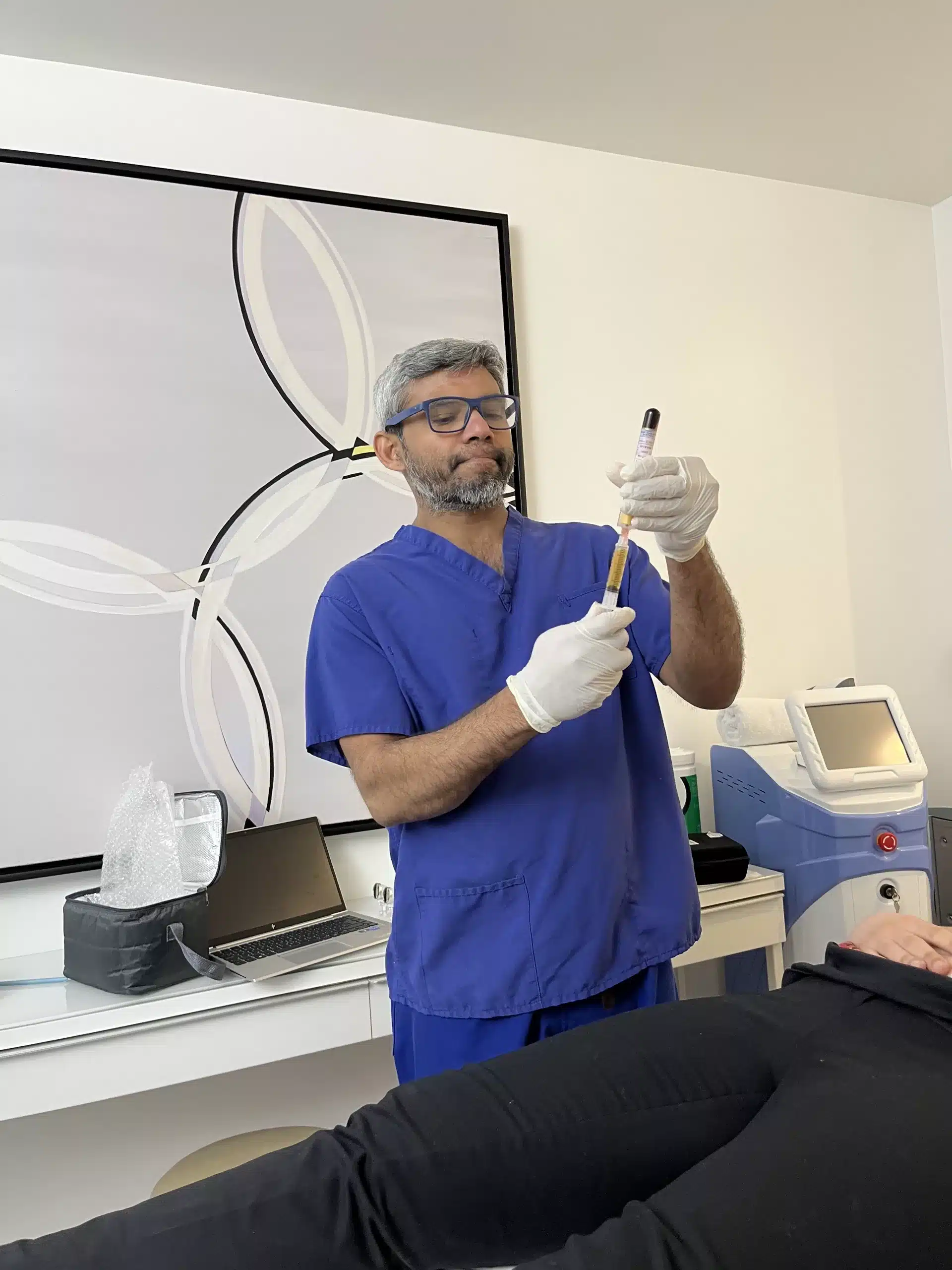
After centrifugation, the blood separates into distinct layers. The clinician identifies and draws the plasma fraction intended for treatment, using the preparation protocol appropriate to the indication.
This is why PRP is more than simply taking blood and reinjecting it: the preparation, concentration and treatment plan all influence how the procedure is performed.
A short Santi explanation of the different plasma layers visible after centrifugation and the fraction used during PRP preparation.
We review goals, medical history, medication, skin or scalp condition and whether PRP is genuinely suitable.
A small blood draw is centrifuged to isolate the platelet-rich fraction under clinical conditions.
PRP is placed into the target area and a course, aftercare and review plan is provided where appropriate.
Commonly three sessions around 4–6 weeks apart, adjusted to indication and response.
Early freshness may appear within weeks, with quality changes building gradually across the course.
Changes in shedding, calibre and density are usually judged over approximately 3–6 months.
PRP is frequently over-marketed. At Santi, the more useful question is whether your particular skin or hair concern is biologically likely to respond.
| Treatment | Main focus | What makes it different |
|---|---|---|
| PRP | Repair signalling, skin quality and selected hair thinning | Autologous platelet concentrate prepared from your own blood. |
| Polynucleotides | Skin quality and tissue support | Injectable biostimulator; useful particularly where delicate skin quality is the main concern. |
| Skin boosters | Hydration, elasticity and glow | Usually HA-based and more directly focused on hydration than PRP. |
| Dermal fillers | Volume, contour and structural support | Different category entirely: filler adds or restores volume rather than acting mainly through repair signalling. |
PRP is autologous, but that does not make it suitable for everyone. Medical history, blood health, medication, infection risk and the underlying diagnosis still matter.
Hair shedding, follicle miniaturisation, iron status, hormones, inflammation, stress and scalp health can all change whether PRP makes sense. We aim to recommend the right pathway rather than simply the currently popular treatment.
I have retained all six of the current PRP guide destinations rather than simplifying them away.
A clear guide to platelet-rich plasma, preparation and treatment rationale.
Read guide →Growth factors, repair signalling, follicle biology and why results vary.
Learn more →Where PRP may help, who responds best and where expectations need to remain realistic.
Explore →Practical pre-treatment guidance for comfort, scalp preparation and recovery.
View checklist →What to avoid and how to look after the skin or scalp before and after PRP.
Read aftercare →How regenerative approaches differ and where each may fit in a treatment plan.
Compare →PRP is autologous, meaning the platelet concentrate is prepared from your own blood. That does not mean it is automatically suitable for everyone, so assessment remains important.
Most clients tolerate it well. Topical anaesthetic may be used for skin, while scalp treatment usually feels like brief pinpricks, pressure or stinging.
No. PRP is aimed at skin quality and repair signalling. Dermal fillers are used where volume, contour or structural support is the main concern.
No. Laser can resurface, tighten or target pigmentation and vessels. PRP may support repair, but it is a different treatment category.
Generally people with early-to-moderate thinning where active or miniaturised follicles remain. Fully bald, shiny or scarred areas usually respond poorly.
Many plans begin with three sessions spaced about 4–6 weeks apart, followed by review and maintenance according to indication and response.
Yes, in selected skin-quality protocols. The combination, sequence and depth should be chosen according to the treatment goal and skin condition.
In selected skin-quality cases, PRP may be combined with hyaluronic acid to add a more direct hydration component. Suitability and pricing are confirmed clinically.
Book a consultation in South Kensington and we’ll advise whether PRP, skin boosters, polynucleotides, laser, hair treatment or another pathway is the most appropriate option.