
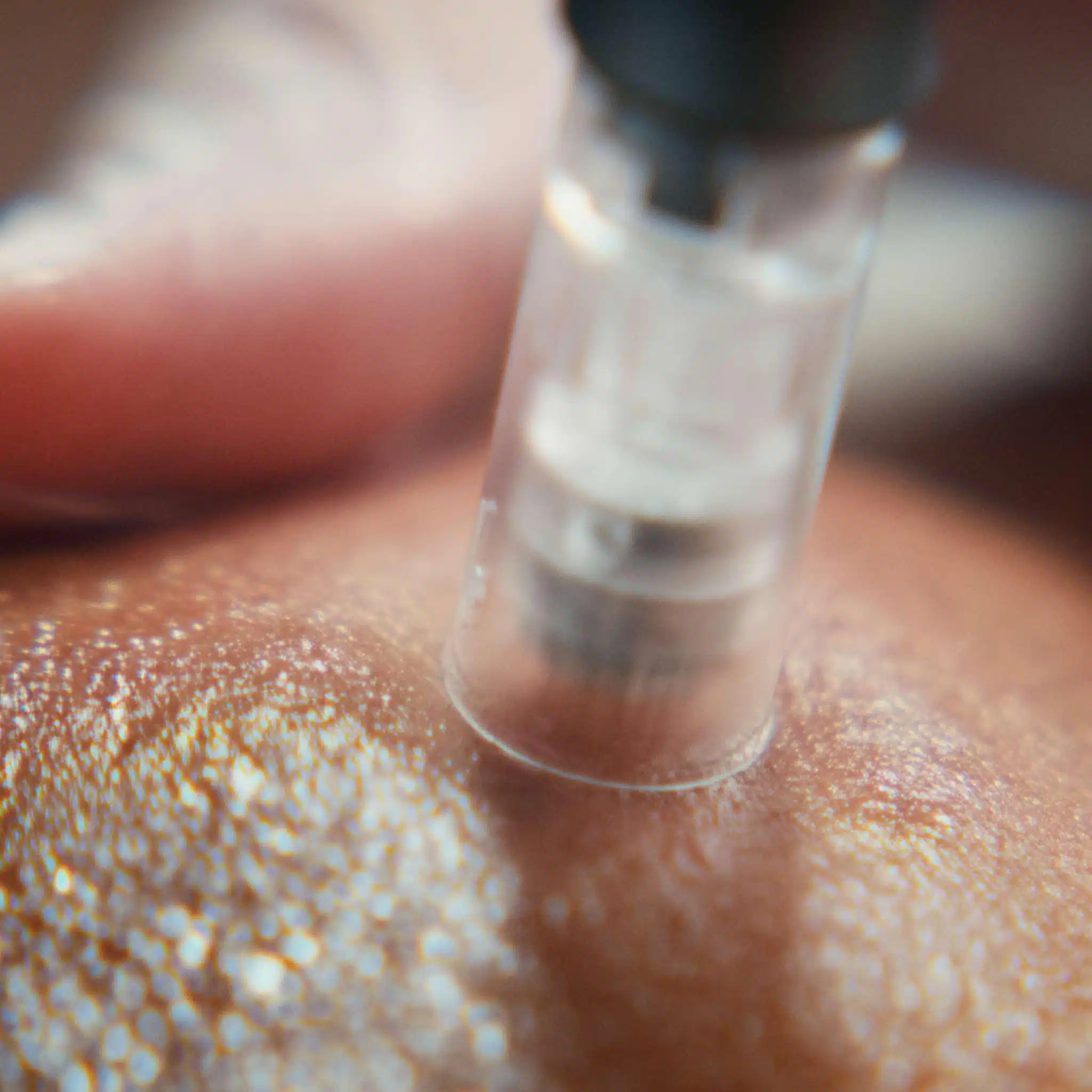
The 0.5mm Secret: Why Deeper Isn’t Always Better for Your Skin
If you have spent time on skincare forums or watched at-home microneedling videos, you have probably come across the idea that deeper needles deliver better results. It sounds logical: if 0.5mm works, surely 1.5mm or 2.0mm must be more powerful. In reality, skin does not respond in such a linear way.
For many common concerns, including dullness, enlarged pores, and fine lines, shallower microneedling depths of around 0.5mm often deliver more consistent, safer, and more visible results over time.
1. Targeting the Most Responsive Layer of the Skin
The skin’s most biologically active zone sits near the dermal–epidermal junction, typically within approximately 0.2mm to 0.6mm depending on the area of the face. This is where important signalling begins between the epidermis and the upper dermis.
Microneedling at around 0.5mm can help stimulate:
- controlled wound healing responses,
- collagen signalling,
- improved epidermal renewal, and
- refinement of surface texture.
Crucially, it does this without unnecessarily disturbing deeper dermal structures, where treatment becomes more inflammatory and recovery becomes more demanding.

Clinical perspective: For general skin rejuvenation, the aim is not simply to create more injury. The aim is to create the right degree of stimulation in the right layer of the skin.
2. Collagen Is Built Through Repetition, Not Aggression
Microneedling is usually more effective when approached as a cumulative process rather than an aggressive one-off event.
- 0.5mm treatments often involve minimal downtime, with mild redness that may settle within 24 to 48 hours.
- Deeper treatments can create significantly more inflammation and usually require longer recovery periods.
Because shallower treatments can often be repeated more regularly, they may produce a better long-term improvement in skin quality, brightness, and smoothness for many people.
3. Matching Depth to the Concern
Not every skin concern lives at the same depth.
Concerns often well suited to around 0.5mm
- Fine lines
- Enlarged pores
- Uneven texture
- Mild surface irregularities
- A general lack of radiance
Concerns that may justify deeper treatment
- Deep acne scarring
- More pronounced dermal textural change
- Selected body concerns, such as stretch marks
For superficial concerns, deeper treatment can be unnecessary. In some cases, it may increase recovery time without proportionately improving the result.
4. Lower Risk, Better Tolerance
As needle depth increases, so does the potential for unwanted effects. These may include:
- post-inflammatory hyperpigmentation,
- prolonged redness,
- barrier disruption,
- sensitivity, and
- textural irregularities if technique is poor.
These risks are especially relevant in darker skin tones and in anyone prone to pigmentation. For that reason, a more measured approach is often the more intelligent one.
So when should you go deeper?
Deeper microneedling absolutely has a place, but it is generally better reserved for specific indications such as deeper acne scarring, selected body concerns, or treatment plans designed and performed in a professional clinical setting.
For most people seeking fresher-looking skin, smoother texture, and softer fine lines, 0.5mm is often the more balanced starting point.
Final Thought
If your aim is brighter skin, refined texture, and a healthy glow, it is worth moving away from the idea that deeper is automatically better. In skin treatment, precision often outperforms aggression.
In that context, 0.5mm is not a compromise. For many aesthetic concerns, it is often the depth that offers the best balance of safety, recovery, and visible improvement.
Santi London
At Santi, we take a considered approach to skin treatment planning, combining clinical judgement with a calm, personalised experience in South Kensington.
33 Thurloe Street, South Kensington, London SW7 2LQ
020 7584 7000